Loading EveryPlace content…
Assisted LivingActive licenseMemory care certified
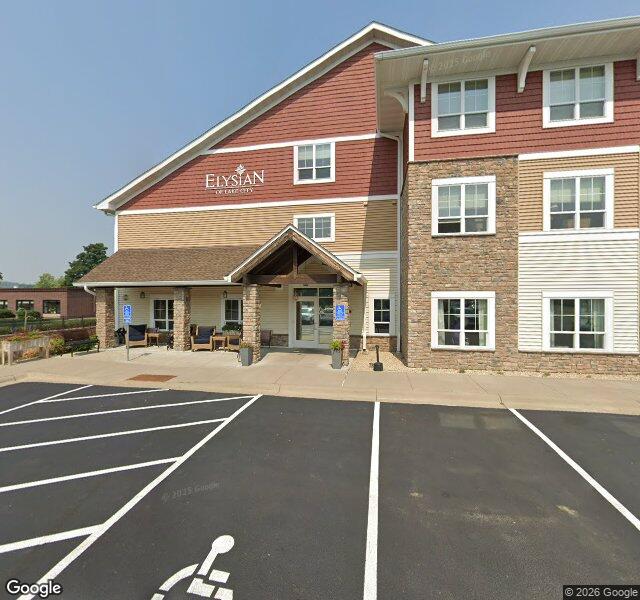
Elysian Senior Homes of Lake C
480 West Grant Street, Lake City, MN 55041View map (opens in a new tab)
Overview and key essentials
State license
Active
MN MDH
Google reviews
3.7/ 5
3 reviews
Size & payment
Ask directly
Confirm pricing & payment
Cost, payment & care details
Updated Nov 28, 2026| Monthly cost | Not published | Ask for the full monthly cost, including care fees and one-time charges. |
|---|---|---|
| Payment options | Ask directly | Payment details are not confirmed in our records. Ask about private pay, long-term care insurance, veterans benefits, and Medicaid waivers. |
| Size & availability | Confirm directly | We don't publish live openings. Ask about current availability, waitlist length, and move-in timing. |
| Care & support | Assisted livingMemory care certified | Usually offers housing and help with everyday tasks, such as bathing and dressing. What to confirm about care levelsThis describes the licensed category. Ask how care plans adjust if mobility, nursing, or memory needs change over time. Read the family care guide → |
State licensing
State inspection history
4inspections
22deficiencies listed
Dec 24, 2024ComplaintNo deficiencies reportedNone
No deficiencies reported
View official state report (opens in a new tab)
Not Substantiated. The facility neglected the resident when it did not identify he had left hand pain, which turned out to be a skin infection
Dec 5, 2024Routine4 deficiencies reported4
4 deficiencies reported
View official state report (opens in a new tab)
144G.41 Subdivision 1 Subd. 1a (a-b) Minimum0480
SS=F requirements; required food services 0 480 STATE FORM
B6RX116899
(a) Except as provided in paragraph (b), food must be prepared and served according to the Minnesota Food Code, Minnesota Rules, chapter 4626. (b) For an assisted living facility with a licensed capacity of ten or fewer residents: (1) notwithstanding Minnesota Rules, part 4626.0033, item A, the facility may share a certified food protection manager (CFPM) with one other facility located within a 60-mile radius and under common management provided the CFPM is present at each facility frequently enough to effectively administer, manage, and supervise each facility's food service operation; (2) notwithstanding Minnesota Rules, part 4626.0545, item A, kick plates that are not removable or cannot be rotated open are allowed unless the facility has been issued repeated correction orders for violations of Minnesota Rules, part 4626.1565 or 4626.1570; (3) notwithstanding Minnesota Rules, part 4626.0685, item A, the facility is not required to provide integral drainboards, utensil racks, or tables large enough to accommodate soiled and clean items that may accumulate during hours of operation provided soiled items do not contaminate clean items, surfaces, or food, and clean equipment and dishes are air dried in a manner that prevents contamination before storage; (4) notwithstanding Minnesota Rules, part 4626.1070, item A, the facility is not required to install a dedicated handwashing sink in its existing kitchen provided it designates one well of a two-compartment sink for use only as a handwashing sink; (5) notwithstanding Minnesota Rules, parts 4626.1325, 4626.1335, and 4626.1360, item A, existing floor, wall, and ceiling finishes are STATE FORM B6RX11 allowed provided the facility keeps them clean and in good condition; (6) notwithstanding Minnesota Rules, part 4626.1375, shielded or shatter-resistant lightbulbs are not required, but if a light bulb breaks, the facility must discard all exposed food and fully clean all equipment, dishes, and surfaces to remove any glass particles; and (7) notwithstanding Minnesota Rules, part 4626.1390, toilet rooms are not required to be provided with a self-closing door. This MN Requirement is not met as evidenced by: Based on observation, interview, and record review, the licensee failed to ensure food was prepared and served according to the Minnesota Food Code. This practice resulted in a level two violation (a violation that did not harm a resident's health or safety but had the potential to have harmed a resident's health or safety, but was not likely to cause serious injury, impairment, or death), and is issued at a widespread scope (when problems are pervasive or represent a systemic failure that has affected or has the potential to affect a large portion or all of the residents). The findings include: Please refer to the document titled, Food and Beverage Establishment Inspection Report (FBEIR) dated December 3, 2024, for the specific Minnesota Food Code violations. The Inspection Report was provided to the licensee within 24 hours of the inspection. TIME PERIOD FOR CORRECTION: Please refer STATE FORM B6RX11 to the FBEIR for any compliance dates. B6RX11 safety but had the potential to have harmed a resident's health or safety, but was not likely to cause serious injury, impairment, or death), and was issued at a widespread scope (when problems are pervasive or represent a systemic failure that has affected or has potential to affect a large portion or all of the residents). Findings...
144G.45 Subd. 2 (b-f) Fire protection and0810
SS=F physical environment (b) Each assisted living facility shall develop and maintain fire safety and evacuation plans. The plans shall include but are not limited to: (1) location and number of resident sleeping rooms; (2) staff actions to be taken in the event of a fire or similar emergency; (3) fire protection procedures necessary for residents; and STATE FORM The findings include: A record review and interview were conducted on December 3, 2024, at approximately1:00 p.m. with the licensed assisted living president (P)-E and corporate director of buildings and grounds (CDBG)-H on the fire safety and evacuation plan for the facility. FIRE/EVACUATION PLAN: While on tour of the facility the P-E stated they do not have a way to deactivate the locked doors in the dementia care side in case of an emergency. While touring we did find a keyed switch and the key to operate it. The surveyor explained to the P-E that the fire safety and evacuation plan shall be updated with the location of the switch and location where the key is located and that the dementia care employees shall be trained on the procedures. This switch shall be tested for proper operation. TIME PERIOD FOR CORRECTION: Twenty-one (21) days. 01650 144G.70 Subd. 4 (f) Service plan, implementation 01650 SS=F and revisions to (f) The service plan must include: (1) a description of the services to be provided, the fees for services, and the frequency of each service, according to the resident's current assessment and resident preferences; (2) the identification of staff or categories of staff who will provide the services; (3) the schedule and methods of monitoring STATE FORM
144G.45 Subd. 2 (a) (1) Fire protection and0780
SS=F physical environment for dwellings or sleeping units, as defined in the State Fire Code: (i) provide smoke alarms in each room used for sleeping purposes; (ii) provide smoke alarms outside each separate sleeping area in the immediate vicinity of bedrooms; (iii) provide smoke alarms on each story within a dwelling unit, including basements, but not including crawl spaces and unoccupied attics; (iv) where more than one smoke alarm is required within an individual dwelling unit or sleeping unit, interconnect all smoke alarms so that actuation of one alarm causes all alarms in the individual dwelling unit or sleeping unit to operate; and (v) ensure the power supply for existing smoke alarms complies with the State Fire Code, except that newly introduced smoke alarms in existing buildings may be battery operated; This MN Requirement is not met as evidenced by: Based on observation and interview, the licensee failed to keep the facility in compliance with the Minnesota Fire Code. The deficient condition has the ability to affect all staff and residents. This practice resulted in a level two violation (a violation that did not harm a resident's health or STATE FORM
Aug 6, 2024Complaint1 deficiency reported1
1 deficiency reported
View official state report (opens in a new tab)
Substantiated, facility responsibility. The facility neglected resident #1 and resident #2 when the facility did not provide sufficient supervision and the two residents engaged in possible sexual activity
severeHL318762060M
The facility neglected resident #1 and resident #2 when the facility did not provide sufficient supervision and the two residents engaged in possible sexual activity. The Minnesota Department of Health determined neglect was substantiated. While the relationship between resident #1 and resident #2 may have been consensual, the facility staff did not assess, document, or implement a plan of care to ensure the residents were free from abuse within the relationship. The investigator conducted interviews with facility staff members, including administrative staff, nursing staff, and unlicensed staff. The investigator contacted decision makers of both residents. The investigation included review of the resident records, facility internal investigation, facility incident reports, staff schedules, related facility policy and procedures. Also, the investigator observed resident and staff interactions during an onsite visit. Page 2 of 4 Both resident #1 and resident #2 resided on the same assisted living memory care unit. During the time that both residents lived there a concern arose that resident #2 would go to resident #1’s room and the two would get undressed together. Resident #1 Resident #1’s diagnoses included Alzheimer’s disease, dementia, and anxiety. Resident #1’s service plan included assistance with medication management, cueing and safety checks. The resident assessment indicated resident #1 had memory impairment, but was able to make oneself understood, and could walk independently. Resident #1’s assessment indicated areas of potential vulnerability and interventions designed to address the area of vulnerability would be described in the resident’s care plan. However, resident #1’s care plan mirrored the same documentation regarding the safety vulnerability; “Interventions designed to address area of vulnerability are described on the residents care plan”. A review of resident #1’s medical record failed to identify interventions addressing the areas of vulnerability identified in neither the RN assessment, care plan nor in the individual abuse prevention plan (IAPP). Resident #2 Resident #2’s diagnoses included dementia, mood disturbance and anxiety. Resident #2’s service plan included assistance with medication management, cueing and safety checks. The resident’s assessment indicated the resident had memory impairment and poor judgement, was unable to identify an unsafe situation(s) and was able to walk independently. A review of resident #2’s medical record did not identify an assessment addressing resident #2’s view of relationship with resident #1. The same document included no...
Dec 2, 2021Routine17 deficiencies reported17
17 deficiencies reported
View official state report (opens in a new tab)
moderate0730
Contents of a resident record include the following for each resident: (1) identifying information, including the resident's name, date of birth, address, and telephone number; (2) the name, address, and telephone number of the resident's emergency contact, legal representatives, and designated representative; (3) names, addresses, and telephone numbers of the resident's health and medical service providers, if known; (4) health information, including medical history, allergies, and when the provider is managing medications, treatments or therapies that require documentation, and other relevant health records; (5) the resident's advance directives, if any; (6) copies of any health care directives, guardianships, powers of attorney, or conservatorships; (7) the facility's current and previous assessments and service plans; (8) all records of communications pertinent to the resident's services; (9) documentation of significant changes in the resident's status and actions taken in response to the needs of the resident, including reporting to the appropriate supervisor or health care professional; (10) documentation of incidents involving the resident and actions taken in response to the needs of the resident, including reporting to the appropriate supervisor or health care professional; (11) documentation that services have been provided as identified in the service plan; (12) documentation that the resident has received and reviewed the assisted living bill of rights; (13) documentation of complaints received and any resolution; (14) a discharge summary, including service termination notice and related documentation, when applicable; and (15) other documentation required under this chapter and relevant to the resident's services or status. This MN Requirement is not met as evidenced by: Based on observation, interview, and record review, the licensee failed to ensure resident records contained all records of communication pertinent to resident services for two of four residents (R1, R4) with records reviewed. This practice resulted in a level two violation (a violation that did not harm a resident's health or safety but had the potential to have harmed a resident's health or safety, but was not likely to cause serious injury, impairment, or death), and was issued at a pattern scope (when more than a limited number of residents are affected, more than a limited number of staff are involved, or the situation has occurred repeatedly; but is not found to be pervasive). The findings include: R1 R1's record lacked evidence of consistent care for treatment of a skin injury with an outside provider (hospice) or evidence of reporting the change in condition to R1's physician. R1's Service Plan Agreement dated October 8, 2021, noted services included medication administration and assistance with activities of daily living. On November 30, 2021, at 8:55 a.m., ULP-B administered medications to R1. R1 was observed to have geri-sleeves (cloth sleeves used to protect skin) on both lower arms. ULP-C stated the geri-sleeves were intended to help prevent R1 from scratching his skin. R1's record included a hospice plan of care, dated November 2, 2021, which indicated services with hospice registered nurse, social worker and physician. R1's Progress Notes dated October 1, 2021 through November 28, 2021, noted the following: -October 4, 2021, noted over the weekend resident has a large skin tear on right elbow. It was an unwitnessed incident to know how...
minor0930
(d) The contract must include a description of the facility's complaint resolution process available to residents, including the name and contact information of the person representing the facility who is designated to handle and resolve complaints. (e) The contract must include a clear and conspicuous notice of: (1) the right under section 144G.54 to appeal the termination of an assisted living contract; (2) the facility's policy regarding transfer of residents within the facility, under what circumstances a transfer may occur, and the circumstances under which resident consent is required for a transfer; (3) contact information for the Office of Ombudsman for Long-Term Care, the Ombudsman for Mental Health and Developmental Disabilities, and the Office of Health Facility Complaints; (4) the resident's right to obtain services from an unaffiliated service provider; This MN Requirement is not met as evidenced by: Based on observation, interview and record review, the licensee failed to execute a written contract with the required content for four of four residents (R1, R2, R3, R4) with records reviewed. This practice resulted in a level one violation (a violation that has no potential to cause more than a minimal impact on the resident and does not affect health or safety), and was issued at a widespread scope (when problems are pervasive or represent a systemic failure that has affected or has potential to affect a large portion or all of the residents). The findings include: R1, R3 and R4 began receiving services under the assisted living licensure on August 1, 2021. R2 began receiving services on August 4, 2021. R1 R1's Service Plan Agreement dated October 8, 2021, noted services included medication administration and assistance with activities of daily living. On November 30, 2021, at 8:55 a.m., unlicensed personnel (ULP)-B administered medications to R1. R1's Assisted Living with Dementia Care Contract was signed October 8, 2021, sixty-nine days after R1 began receiving services under the assisted living licensure. The contract lacked the following required content: -the facility's policy regarding transfer of residents within the facility, under what circumstances a transfer may occur, and the circumstances under which resident consent is required for a transfer. R2 R2's Service Plan Agreement dated August 4, 2021, noted services included assistance with activities of daily living, medication management and treatment management. On November 30, 2021, at 9:15 a.m., ULP-C assisted R2 with dressing, grooming, personal hygiene and medication administration. R2's Assisted Living with Dementia Care Contract was signed August 4, 2021. The contract lacked the following required content: -the facility's policy regarding transfer of residents within the facility, under what circumstances a transfer may occur, and the circumstances under which resident consent is required for a transfer. R3 R3's Service Plan Agreement dated August 18, 2021, noted services included medication administration and assistance with activities of daily living. On December 1, 2021, at approximately 11:25 a.m., ULP-E assisted R3 to transfer to his wheelchair for lunch. R3's Assisted Living with Dementia Care Contract was signed August 18, 2021, eighteen days after R3 began receiving services under the assisted living licensure. The contract lacked the following required content: -the facility's policy regarding transfer of residents within the facility, under...
STATE FORM6899
ZPTC12 STATE FORM ZPTC12 STATE FORM ZPTC12 {0 480} {0 480} This MN Requirement is not met as evidenced by: No further action required. {0 650} SS=C 144G.42 Subd. 8 Employee records (a) The facility must maintain current records of each paid employee, each regularly scheduled volunteer providing services, and each individual contractor providing services. The records must include the following information: (1) evidence of current professional licensure, registration, or certification if licensure, registration, or certification is required by this chapter or rules; (2) records of orientation, required annual training and infection control training, and competency evaluations; (3) current job description, including qualifications, responsibilities, and identification of staff persons providing supervision; (4) documentation of annual performance reviews that identify areas of improvement needed and training needs; (5) for individuals providing assisted living services, verification that required health screenings under subdivision 9 have taken place and the dates of those screenings; and (6) documentation of the background study as required under section 144.057. (b) Each employee record must be retained for at least three years after a paid employee, volunteer, or contractor ceases to be employed by, provide services at, or be under contract with the facility. If a facility ceases operation, STATE FORM ZPTC12 {0 650} {0 650} employee records must be maintained for three years after facility operations cease. This MN Requirement is not met as evidenced by: Based on interview and record review, the licensee failed to ensure employee records contained the required content for four of four employees (unlicensed personnel (ULP)-D, ULP-C, ULP-S and ULP-T) with records reviewed. This practice resulted in a level one violation (a violation that has no potential to cause more than a minimal impact on the resident and does not affect health or safety), and was issued at a widespread scope (when problems are pervasive or represent a systemic failure that has affected or has potential to affect a large portion or all of the residents). The findings include: ULP-D ULP-D started employment on April 18, 2019, under the comprehensive home care license and began providing assisted living services on August 1, 2021. ULP-D's record lacked documented evidence of the following required training: - review of the types of Assisted Living services the employee would provide and the provider's scope of license. ULP-C ULP-C started employment on April 18, 2019, under the comprehensive home care license and began providing assisted living services on August 1, 2021. STATE FORM ZPTC12 {0 650} {0 650} ULP-C's record lacked documented evidence of the following required training: - review of the types of Assisted Living services the employee would provide and the provider's scope of license. ULP-S ULP-S began providing assisted living services on December 27, 2021. ULP-S's record lacked documented evidence of the following required training: - review of the types of Assisted Living services the employee would provide and the provider's scope of license. ULP-T ULP-T began providing assisted living services on February 15, 2022. ULP-T's record lacked documented evidence of the following required training: - review of the types of Assisted Living services the employee would provide and the provider's scope of license. On February 25, 2022, at 9:10 a.m.,...
moderate0680
emergency preparedness (a) The facility must meet the following requirements: (1) have a written emergency disaster plan that contains a plan for evacuation, addresses elements of sheltering in place, identifies temporary relocation sites, and details staff assignments in the event of a disaster or an emergency; (2) post an emergency disaster plan prominently; (3) provide building emergency exit diagrams to all residents; (4) post emergency exit diagrams on each floor; and (5) have a written policy and procedure regarding missing tenant residents. (b) The facility must provide emergency and disaster training to all staff during the initial staff orientation and annually thereafter and must make emergency and disaster training annually available to all residents. Staff who have not received emergency and disaster training are allowed to work only when trained staff are also working on site. (c) The facility must meet any additional requirements adopted in rule. This MN Requirement is not met as evidenced by: Based on observation, interview and record review, the licensee failed to have a written emergency preparedness plan with all of the required content. This had the potential to affect all 44 current residents, staff, and visitors. This practice resulted in a level two violation (a violation that did not harm a resident's health or safety but had the potential to have harmed a resident's health or safety, but was not likely to cause serious injury, impairment, or death), and is issued at a widespread scope (when problems are pervasive or represent a systemic failure that has affected or has the potential to affect a large portion or all of the residents). The findings include: During the entrance conference on November 29, 2021, at approximately 1:20 p.m., a request was made to view the licensee's emergency preparedness plan, which was provided and later reviewed by surveyors. On November 29, 2021, at approximately 1:50 p.m., a facility tour was conducted with president (P)-I. Emergency exit diagrams were posted outside the elevator on each floor. The emergency preparedness plan was noted in the foyer, and on a table in the commons area for the residents. The licensee's plan lacked identification of the residents' ambulatory status. On December 2, 2021, at approximately 1:00 p.m., certified facility property manager (CFPM)-H confirmed the above required content was not in the binder provided. CFPM-H later produced a list with the required information and placed it in the binder. The licensee's Emergency Preparedness Plan - Appendix Z Compliance policy dated August 1, 2021, noted the emergency preparedness plan would include all required elements of appendix Z. No further information was provided. TIME PERIOD FOR CORRECTION: Twenty-One (21) days
moderate0480
requirements (13) offer to provide or make available at least the following services to residents: (i) at least three nutritious meals daily with snacks available seven days per week, according to the recommended dietary allowances in the United States Department of Agriculture (USDA) guidelines, including seasonal fresh fruit and fresh vegetables. The following apply: (B) food must be prepared and served according to the Minnesota Food Code, Minnesota Rules, chapter 4626; and This MN Requirement is not met as evidenced by: Based on observation, interview, and record review, the licensee failed to ensure food was prepared and served according to the Minnesota Food Code. This practice resulted in a level two violation (a violation that did not harm a resident's health or safety but had the potential to have harmed a resident's health or safety) and was issued at a widespread scope (when problems are pervasive or represent a systemic failure that has affected or has the potential to affect a large portion or all the residents). The findings include: Please refer to the included document titled, Food and Beverage Establishment Inspection Report, dated November 30, 2021, for the specific Minnesota Food Code deficiencies. TIME PERIOD FOR CORRECTION: Twenty-one (21) days
minor0430
services (a) All assisted living facilities must provide to prospective residents: (1) a disclosure of the categories of assisted living licenses available and the category of license held by the facility; (2) a written checklist listing all services permitted under the facility's license, identifying all services the facility offers to provide under the assisted living facility contract, and identifying all services allowed under the license that the facility does not provide; and (3) an oral explanation of the services offered under the contract. (b) The requirements of paragraph (a) must be completed prior to the execution of the assisted living contract. (c) The commissioner must, in consultation with all interested stakeholders, design the uniform checklist disclosure form for use as provided under paragraph (a). This MN Requirement is not met as evidenced by: Based on observation, interview and record review, the licensee failed to provide a copy of the uniform disclosure of assisted living services and amenities (UDALSA) prior to providing assisted living services, for three of four residents (R1, R3 and R4) with records reviewed. This practice resulted in a level one violation (a violation that has not potential to cause more than a minimal impact on the resident and does not affect health or safety), and was issued at a pattern scope (when more than a limited number of residents are affected, more than a limited number of staff are involved, or the situation has occurred repeatedly, but is not found to be pervasive). The findings include: R1, R3 and R4 began receiving services under the assisted living licensure on August 1, 2021. R1 R1's Service Plan Agreement dated October 8, 2021, noted services included medication administration and assistance with activities of daily living. On November 30, 2021, at 8:55 a.m., unlicensed personnel (ULP)-B administered medications to R1. R1's Assisted Living with Dementia Care Contract, was dated October 8, 2021, and included the UDALSA being provided at the time the contract was signed, after R1 began receiving services under the assisted living licensure on August 1, 2021. R3 R3's Service Plan Agreement dated August 18, 2021, noted services included medication administration and assistance with activities of daily living. On December 1, 2021, at approximately 11:25 a.m., ULP-E assisted R3 to transfer to his wheelchair for lunch. R4 R4's Service Plan Agreement dated August 28, 2021, noted services included medication administration and assistance with activities of daily living. On November 30, 2021, at approximately 8:38 a.m., ULP-E and ULP-O assisted R4 with morning cares and to transfer with a full body lift into his recliner. On December 2, 2021, at approximately 7:50 a.m., registered nurse (RN)-A and RN-K confirmed all residents that had been admitted prior to August 1, 2021, received the UDALSA at the time of the contract being signed, after they began receiving services under the assisted living licensure. The licensee's Uniform Disclosure of Assisted Living Services & Amenities policy dated August 1, 2021, noted the licensee would provide a UDALSA to prospective residents prior to signing an assisted living contract. No further information was provided. TIME PERIOD FOR CORRECTION: Twenty-One (21) days
moderate0810
physical environment (b) Each assisted living facility shall develop and maintain fire safety and evacuation plans. The plans shall include but are not limited to: (1) location and number of resident sleeping rooms; (2) employee actions to be taken in the event of a fire or similar emergency; (3) fire protection procedures necessary for residents; and (4) procedures for resident movement, evacuation, or relocation during a fire or similar emergency including the identification of unique or unusual resident needs for movement or evacuation. (c) Employees of assisted living facilities shall receive training on the fire safety and evacuation plans upon hiring and at least twice per year thereafter. (d) Fire safety and evacuation plans shall be readily available at all times within the facility. (e) Residents who are capable of assisting in their own evacuation shall be trained on the proper actions to take in the event of a fire to include movement, evacuation, or relocation. The training shall be made available to residents at least once per year. (f) Evacuation drills are required for employees twice per year per shift with at least one evacuation drill every other month. Evacuation of the residents is not required. Fire alarm system activation is not required to initiate the evacuation drill. This MN Requirement is not met as evidenced by: Based on interview and record review, the facility failed to provide documentation of procedures for resident movement, evacuation, or relocation during a fire or similar emergency including the identification of unique or unusual resident needs for movement or evacuation. This had the potential to affect all current residents, staff, and visitors. This practice resulted in a level two violation (a violation that did not harm a resident's health or safety but had the potential to have harmed a resident's health or safety), and was issued at a widespread scope (when problems are pervasive or represent a systemic failure that has affected or has the potential to affect a large portion or all of the residents). The findings include: On November 30, 2021, at approximately 1:00 p.m., during review of fire safety and evacuation records, the licensee's policy lacked documentation of procedures for resident movement, evacuation, or relocation during a fire or similar emergency including the identification of unique or unusual resident needs for movement or evacuation. Certified facility property manager (CFPM)-H and director of building and grounds (DBG)-J confirmed they had not documented resident needs for movement or evacuation. A policy related to a plan for procedures for resident movement, evacuation, or relocation during a fire or similar emergency including the identification of unique or unusual resident needs for movement or evacuation was requested, but not available. No further information was provided. TIME PERIOD FOR CORRECTION: Twenty-one (21) days
moderate0970
The contract must not include a waiver of facility liability for the health and safety or personal property of a resident. The contract must not include any provision that the facility knows or should know to be deceptive, unlawful, or unenforceable under state or federal law, nor include any provision that requires or implies a lesser standard of care or responsibility than is required by law. This MN Requirement is not met as evidenced by: Based on interview and record review, the licensee failed to ensure the assisted living contract did not include language waiving the facility's liability for health, safety or personal property of a resident. This had the potential to affect all residents. This practice resulted in a level two violation (a violation that did not harm a resident's health or safety but had the potential to have harmed a resident's health or safety), and was issued at a widespread scope (when problems are pervasive or represent a systemic failure that has affected or has the potential to affect a large portion or all of the residents). The findings include: The licensee's assisted living contract included three clauses that indicated the resident would waive the facility's liability for health, safety or personal property of a resident. -Page 10, section 10 (a) of the contract indicated "We have no responsibility to you or any third party for any personal property placed in the apartment or on any other location within the company by you or the owner of such personal property. We are not responsible to you or any third party for harm or loss of any personal property by theft or any other cause. You assume all risk for harm to or loss of any of your personal property and agree to release, indemnify, defend, and hold us harmless from any and all liability with respect to harm to or loss of any of your personal property." -Page 10, section 10 (b) of the contract indicated "You are solely responsible for personal injury, property damage, or other loss as a result of your owning, maintaining, operating and/or parking of a motor vehicle on or off the premises of the company. You assume all risk for harm to or loss of your motor vehicle, and agree to release, indemnify, defend, and hold us harmless from any and all liability connected with your owning, maintaining, operating, and/or parking a motor vehicle." -Page 10, section 10 (c) indicated "You acknowledge familiarity with the apartment, the company premises and services of the company and are therefore are willing to, and do, assume all risks associated with occupancy. You further acknowledge that we are not an insurer of your safety. The company, its employees, and its agents are not liable to you or to any other person for any loss of inconvenience of any kind, including personal injuries sustained by you or any other person, or any loss or damage to property of any kind, including personal injuries sustained by you or any other person, or any loss or damage to property, which is not the direct result of our intentional or negligent acts in violation of applicable standards of care. We are not responsible for the actions of, or for any damages, injury or harm cause by third parties (such as other residents, family members, guests, intruders, or trespassers) who are not under our control. On February 25, 2022, at 3:47 p.m., president (P)-I verified the licensee's contract included the above content, and stated the same contract was utilized for all residents at the...
moderate0250
(a) The commissioner may refuse to grant a provisional license, refuse to grant a license as a result of a change in ownership, refuse to renew a license, suspend or revoke a license, or impose a conditional license if the owner, controlling individual, or employee of an assisted living facility: (1) is in violation of, or during the term of the license has violated, any of the requirements in this chapter or adopted rules; (2) permits, aids, or abets the commission of any illegal act in the provision of assisted living services; (3) performs any act detrimental to the health, safety, and welfare of a resident; (4) obtains the license by fraud or misrepresentation; (5) knowingly makes a false statement of a material fact in the application for a license or in any other record or report required by this chapter; (6) denies representatives of the department access to any part of the facility's books, records, files, or employees; (7) interferes with or impedes a representative of the department in contacting the facility's residents; (8) interferes with or impedes ombudsman access according to section 256.9742, subdivision 4; (9) interferes with or impedes a representative of the department in the enforcement of this chapter or fails to fully cooperate with an inspection, survey, or investigation by the department; (10) destroys or makes unavailable any records or other evidence relating to the assisted living facility's compliance with this chapter; (11) refuses to initiate a background study under section 144.057 or 245A.04; (12) fails to timely pay any fines assessed by the commissioner; (13) violates any local, city, or township ordinance relating to housing or assisted living services; (14) has repeated incidents of personnel performing services beyond their competency level; or (15) has operated beyond the scope of the assisted living facility's license category. (b) A violation by a contractor providing the assisted living services of the facility is a violation by the facility. This MN Requirement is not met as evidenced by: Based on observation, interview and record review, the licensee failed to show they had met the requirements of licensure, by attesting the managerial officials who were in charge of the day-to-day operations, had developed and implemented current policies and procedures, as required, with records reviewed. This practice resulted in a level two violation (a violation that did not harm a resident's health or safety but had the potential to have harmed a resident's health or safety, but was not likely to cause serious injury, impairment, or death), and is issued at a widespread scope (when problems are pervasive or represent a systemic failure that has affected or has the potential to affect a large portion or all of the residents). The findings include: During the entrance conference on November 29, 2021, at approximately 1:20 p.m., registered nurse (RN)-A, president (P)-I, and corporate RN (CRN)-N stated they viewed the regulations online and in the printed book. The licensee's "Application for Assisted Living License", section titled "Official Verification of Owner or Authorized Agent", (page four and five of the application), identified, "I certify I have read and understand the following:" [a check mark was placed before each of the following]: - I have read and fully understand Minn. [Minnesota] Stat. [statute] sect. [section] 144G.45 (opens in a new window), my building(s) must comply with...
moderate0340
(a) A correction order may be issued whenever the commissioner finds upon survey or during a complaint investigation that a facility, a managerial official, or an employee of the facility is not in compliance with this chapter. The correction order shall cite the specific statute and document areas of noncompliance and the time allowed for correction. (b) The commissioner shall mail or e-mail copies of any correction order to the facility within 30 calendar days after the survey exit date. A copy of each correction order and copies of any documentation supplied to the commissioner shall be kept on file by the facility and public documents shall be made available for viewing by any person upon request. Copies may be kept electronically. (c) By the correction order date, the facility must document in the facility's records any action taken to comply with the correction order. The commissioner may request a copy of this documentation and the facility's action to respond to the correction order in future surveys, upon a complaint investigation, and as otherwise needed. This MN Requirement is not met as evidenced by: Based on interview and record review, the licensee failed to have sufficient documentation with actions taken to comply with the correction orders for a revisit survey completed on February 25, 2022, with records reviewed. This practice resulted in a level two violation (a violation that did not harm a resident's health or safety but had the potential to have harmed a resident's health or safety, but was not likely to cause serious injury, impairment, or death), and was issued at a widespread scope (when problems are pervasive or represent a systemic failure that has affected or has the potential to affect a large portion or all of the residents). The findings include: During the revisit survey on February 24, 2022, through February 25, 2022, surveyors reviewed the licensee's policies and procedures, resident records, employee records, and conducted interviews with president (P)-I, corporate registered nurse (CRN)-N and RN-M. The licensee lacked evidence to indicate the orders issued on December 2, 2021, were corrected. No further information was provided. TIME PERIOD FOR CORRECTION: Seven (7) days {0 480} SS=F 144G.41 Subd 1 (13) (i) (B) Minimum requirements (13) offer to provide or make available at least the following services to residents: (i) at least three nutritious meals daily with snacks available seven days per week, according to the recommended dietary allowances in the United States Department of Agriculture (USDA) guidelines, including seasonal fresh fruit and fresh vegetables. The following apply: (B) food must be prepared and served according to the Minnesota Food Code, Minnesota Rules, chapter 4626; and
moderate0900
(a) An assisted living facility may not offer or provide housing or assisted living services to any individual unless it has executed a written contract with the resident. (b) The contract must contain all the terms concerning the provision of: (1) housing; (2) assisted living services, whether provided directly by the facility or by management agreement or other agreement; and (3) the resident's service plan, if applicable. (c) A facility must: (1) offer to prospective residents and provide to the Office of Ombudsman for Long-Term Care a complete unsigned copy of its contract; and (2) give a complete copy of any signed contract and any addendums, and all supporting documents and attachments, to the resident promptly after a contract and any addendum has been signed. (d) A contract under this section is a consumer contract under sections 325G.29 to 325G.37. (e) Before or at the time of execution of the contract, the facility must offer the resident the opportunity to identify a designated representative according to subdivision 3. (f) The resident must agree in writing to any additions or amendments to the contract. Upon agreement between the resident and the facility, a new contract or an addendum to the existing contract must be executed and signed. This MN Requirement is not met as evidenced by: Based on observation, interview and record review, the licensee failed to execute a written contract prior to providing assisted living services for three of four residents (R1, R3, R4) with records reviewed. This practice resulted in a level two violation (a violation that did not harm a resident's health or safety but had the potential to have harmed a resident's health or safety, but was not likely to cause serious injury, impairment, or death), and was issued at a widespread scope (when problems are pervasive or represent a systemic failure that has affected or has the potential to affect a large portion or all of the residents). The findings include: R1, R3 and R4 began receiving services under the assisted living licensure on August 1, 2021. R1 R1's Service Plan Agreement dated October 8, 2021, noted services included medication administration and assistance with activities of daily living. On November 30, 2021, at 8:55 a.m., unlicensed personnel (ULP)-B administered medications to R1. R1's Assisted Living with Dementia Care Contract was signed October 8, 2021, sixty-nine days after R1 began receiving services under the assisted living licensure on August 1, 2021. On December 2, 2021, at approximately 11:55 a.m., registered nurse (RN)-M and RN-A verified R1's contract was signed after R1 began receiving services under the assisted living licensure. R3 R3's Service Plan Agreement dated August 18, 2021, noted services included medication administration and assistance with activities of daily living. On December 1, 2021, at approximately 11:25 a.m., ULP-E assisted R3 to transfer to his wheelchair for lunch. R3's Assisted Living with Dementia Care Contract was signed August 18, 2021, eighteen days after R3 began receiving services under the assisted living licensure. R4 R4's Service Plan Agreement dated August 28, 2021, noted service included medication administration and assistance with activities of daily living. On November 30, 2021, at approximately 8:38 a.m., ULP-E and ULP-O assisted R4 with morning cares and to transfer to his recliner. R4's Assisted Living with Dementia Care Contract was signed August 28, 2021, twenty-eight...
recommended dimensional measurements2006
to reduce entrapment. The March 10, 2006, FDA Side Rail Entrapment Zones and Dimensional Recommendations indicated to reduce the risk of entrapment, zone 1 (within the rail) should not exceed 4 and 3/4 inches, zone 2 (under the rail, between rail supports or next to a single rail support) should not exceed 4 and 3/4 inches, zone 3 (between the rail and the mattress), should not exceed 4 and 3/4 inches, and zone 4 (under the rail, at the ends of the rail) should not exceed 2 and 3/8 inches or be greater than a 60 degree angle. The FDA, "A Guide to Bed Safety" revised April 2010, included the following information: "When bed rails are used, perform an on-going assessment of the patient's physical and mental status, closely monitor high-risk patients. The FDA also identified; "Patients who have problems with memory, sleeping, incontinence, pain, uncontrolled body movement, or who get out of bed and walk unsafely without assistance, must be carefully assessed for the best ways to keep them from harm, such as falling. Assessment by the patient's health care team will help to determine how best to keep the patient safe". TIME PERIOD FOR CORRECTION: Immediate Immediacy is removed as confirmed by communication between licensee, surveyor and review by evaluation supervisor on March 1, 2022, however noncompliance remains at a scope and severity of G. recommended dimensional measurements to reduce entrapment. The March 10, 2006, FDA Side Rail Entrapment Zones and Dimensional Recommendations indicated to reduce the risk of entrapment, zone 1 (space between the rails), should be less than 4 and 3/4 inches. The FDA, "A Guide to Bed Safety" revised April 2010, included the following information: "When bed rails are used, perform an on-going assessment of the patient's physical and mental status, closely monitor high-risk patients. The FDA also identified; "Patients who have problems with memory, sleeping, incontinence, pain, uncontrolled body movement, or who get out of bed and walk unsafely without assistance, must be carefully assessed for the best ways to keep them from harm, such as falling. Assessment by the patient's health care team will help to determine how best to keep the patient safe". OXYGEN STORAGE On November 30, 2021, at approximately 8:40 a.m., the surveyor observed R3 in his room, sitting in the recliner. The room contained seven oxygen tanks in a black plastic holder on the floor, and eight oxygen tanks, which were standing upright on the floor, not in a holder, or supported.
moderate0510
(a) All assisted living facilities must establish and maintain an infection control program that complies with accepted health care, medical, and nursing standards for infection control. (b)The facility's infection control program must be consistent with current guidelines from the national Centers for Disease Control and Prevention (CDC) for infection prevention and control in long-term care facilities and, as applicable, for infection prevention and control in assisted living facilities. (c) The facility must maintain written evidence of compliance with this subdivision. This MN Requirement is not met as evidenced by: Based on observation, interview and record review, the licensee failed to establish and maintain an infection control program to comply with accepted health care, medical, and nursing standards for infection control and current recommendations for COVID-19. This deficient practice had the potential to affect the licensee's 44 residents, staff, and visitors. This practice resulted in a level two violation (a violation that did not harm a resident's health or safety but had the potential to have harmed a resident's health or safety, but was not likely to cause serious injury, impairment, or death), and was issued at a widespread scope (when problems are pervasive or represent a systemic failure that has affected or has potential to affect a large portion or all of the residents). The findings include: Infection Control: On November 30, 2021, at approximately 7:35 a.m., unlicensed personnel (ULP)-D performed blood glucose monitoring on R8 in his room. ULP-D donned clean gloves, wiped R8's right ring finger with an alcohol wipe and poked it with a lancet to draw blood. A sample of blood was placed on the strip and into the glucometer. ULP-D brought the lancet to the counter in the kitchen and placed it on a paper towel. Without removing gloves or performing hand hygiene, ULP-D brought the insulin pen to R8 and administered the insulin after wiping an area on the lower left quadrant of R8's abdomen. ULP-D brought the pen back to the counter and again placed it on the paper towel. ULP-D began opening cupboards, looking for a glass to put water in, but was unable to locate one. ULP-D opened the refrigerator and removed a bottle of water from the door. After ULP-D administered all medications, she removed her gloves, washed her hands in the sink, wrapped the glucometer, lancet, and insulin pen in the paper towel, and returned to the medication cart. ULP-D unlocked the medication cart and placed the glucometer inside, without cleaning it after use. On November 30, 2021, at approximately 8:15 a.m., ULP-D verified she had not removed her gloves or performed hand hygiene after performing the blood glucose check and prior to touching multiple surfaces and stated she should have done so. In addition, ULP-D confirmed she had not cleaned the glucometer after use, before placing it in the medication cart, and acknowledged she should have cleaned it with an alcohol wipe after use. On December 1, 2021, at approximately 2:25 p.m., registered nurse (RN)-A stated staff should wash hands after removing gloves and should clean the glucometer with an alcohol wipe or a Sani wipe after each use. On November 30, 2021, at approximately 8:38 a.m., ULP-E and ULP-O assisted R4 to get up for the day. ULP-E and ULP-O donned gloves, opened R4's incontinence brief, and ULP-O used a disposable wipe to clean R4's perineal area, which contained stool....
moderate0690
(a) Assisted living facilities must maintain records for each resident for whom it is providing services. Entries in the resident records must be current, legible, permanently recorded, dated, and authenticated with the name and title of the person making the entry. This MN Requirement is not met as evidenced by: Based on observation, interview, and record review, the licensee failed to maintain permanently recorded records for medication setup for one of one resident (R7) with record reviewed. This practice resulted in a level two violation (a violation that did not harm a resident's health or safety but had the potential to have harmed a resident's health or safety, but was not likely to cause serious injury, impairment, or death), and was issued at an isolated scope (when one or a limited number of residents are affected or one or a limited number of staff are involved or the situation has occurred only occasionally). The findings include: The licensee failed to ensure documentation of medications setup in a medication dosage box was recorded permanently and was current at the time of setup. On November 30, 2021, at 11:33 a.m., registered nurse (RN)-M placed medications into a medication cassette for a one-week supply of medications for the times of 8:00 a.m., 2:00 p.m., 5:00 p.m., and 8:00 p.m., for R7. During the observation, medications were short in supply for the amount needed to setup for the entire week as follows: -divalproex sodium (anti-seizure used for mood stabilization) 125 milligrams (mg) one capsule for 8:00 p.m. dose -donepezil (used to treat dementia) 23 mg one tablet for 8:00 p.m. dose -duloxetine (used to treat depression/anxiety) 60 mg one capsule for 5:00 p.m. dose -memantine (used to treat dementia) 10 mg five tablets for 8:00 p.m. dose -trazodone (used for sleep) 50 mg two tablets for 8:00 p.m. dose Upon completion of the medication setup, RN-M used a pen to sign her initials on a paper medication administration record (MAR) for all seven days from December 7, 2021 through December 13, 2021 for the times noted above. Surveyor inquired with RN-M as to why she documented the placement of the medications in the dosage box for which there was no supply. RN-M stated she should not have signed for setup of the medications for the doses for which there was no supply. RN-M then used Wite-Out to correct the documented areas on the MAR. Surveyor inquired about utilizing correction fluid for documentation changes on the MAR. RN-M stated, "I guess for documentation, I should not have". RN-M stated she should have crossed off the areas documented in error with a pen. On November 30, 2021, at 11:33 a.m., RN-M and surveyor completed a count for accuracy of R7's remaining lorazepam (controlled substance medication used to treat anxiety) 0.5 mg tablets. Page 179 of the licensee's record book (used for recording counts of controlled substances) indicated lorazepam 0.5 mg take one tablet every two hours as needed (maximum of three doses per day), noted on August 25, 2021, quantity on hand was "90" with "7" tablets used and the quantity that remained was "83". There were no other notations documented. In the presence of the surveyor, RN-M counted the number of tablets inside of R7's lorazepam medication bottle, which revealed 78 tablets. RN-M stated she sets up the lorazepam in a single medication dose box (one week supply of seven tablets total) and that the box was double locked within the medication cart for staff to...
minor0940
(5) a description of the facility's policies related to medical assistance waivers under chapter 256S and section 256B.49 and the housing support program under chapter 256I, including: (i) whether the facility is enrolled with the commissioner of human services to provide customized living services under medical assistance waivers; (ii) whether the facility has an agreement to provide housing support under section 256I.04, subdivision 2, paragraph (b); (iii) whether there is a limit on the number of people residing at the facility who can receive customized living services or participate in the housing support program at any point in time. If so, the limit must be provided; (iv) whether the facility requires a resident to pay privately for a period of time prior to accepting payment under medical assistance waivers or the housing support program, and if so, the length of time that private payment is required; (v) a statement that medical assistance waivers provide payment for services, but do not cover the cost of rent; (vi) a statement that residents may be eligible for assistance with rent through the housing support program; and (vii) a description of the rent requirements for people who are eligible for medical assistance waivers but who are not eligible for assistance through the housing support program; (6) the contact information to obtain long-term care consulting services under section 256B.0911; and (7) the toll-free phone number for the Minnesota Adult Abuse Reporting Center. This MN Requirement is not met as evidenced by: Based on observation, interview and record review, the licensee failed to execute a written contract with the required content for four of four residents (R1, R2, R3, R4) with records reviewed. This practice resulted in a level one violation (a violation that has no potential to cause more than a minimal impact on the resident and does not affect health or safety), and was issued at a widespread scope (when problems are pervasive or represent a systemic failure that has affected or has potential to affect a large portion or all of the residents). The findings include: R1, R3 and R4 began receiving services under the assisted living licensure on August 1, 2021. R2 began receiving services on August 4, 2021. R1's Service Plan Agreement dated October 8, 2021, noted services included medication administration and assistance with activities of daily living. On November 30, 2021, at 8:55 a.m., unlicensed personnel (ULP)-B administered medications to R1. R1's Assisted Living with Dementia Care Contract was signed October 8, 2021, sixty-nine days after R1 began receiving services under the assisted living licensure. The contract lacked the following required content: -whether the facility had an agreement to provide housing support under section 256I.04, subdivision 2, paragraph (b); -whether there was a limit on the number of people residing at the facility who could receive customized living services or participate in the housing support program at any point in time. If so, the limit must be provided; -a statement that medical assistance waivers provide payment for services, but do not cover the cost of rent; and -a description of the rent requirements for people who are eligible for medical assistance waivers but who are not eligible for assistance through the housing support program. R2 R2's Service Plan Agreement dated August 4, 2021, noted services included assistance with activities of daily living,...
minor0650
(a) The facility must maintain current records of each paid employee, each regularly scheduled volunteer providing services, and each individual contractor providing services. The records must include the following information: (1) evidence of current professional licensure, registration, or certification if licensure, registration, or certification is required by this chapter or rules; (2) records of orientation, required annual training and infection control training, and competency evaluations; (3) current job description, including qualifications, responsibilities, and identification of staff persons providing supervision; (4) documentation of annual performance reviews that identify areas of improvement needed and training needs; (5) for individuals providing assisted living services, verification that required health screenings under subdivision 9 have taken place and the dates of those screenings; and (6) documentation of the background study as required under section 144.057. (b) Each employee record must be retained for at least three years after a paid employee, volunteer, or contractor ceases to be employed by, provide services at, or be under contract with the facility. If a facility ceases operation, employee records must be maintained for three years after facility operations cease. This MN Requirement is not met as evidenced by: Based on interview and record review, the licensee failed to ensure employee records contained the required content for three of three employees (registered nurse (RN)-A, unlicensed personnel (ULP)-D, and ULP-C) with records reviewed. This practice resulted in a level one violation (a violation that has no potential to cause more than a minimal impact on the resident and does not affect health or safety), and was issued at a widespread scope (when problems are pervasive or represent a systemic failure that has affected or has potential to affect a large portion or all of the residents). The findings include: RN-A started employment on April 18, 2019, under the comprehensive home care license and began providing assisted living services on August 1, 2021. RN-A's record lacked documented evidence of the following required training: - an overview of the Assisted Living statutes - a review of the provider's policies and procedures - handling of resident complaints, reporting of complaints, and where to report - review of the types of Assisted Living services the employee would provide and the provider's scope of license. ULP-D started employment on April 18, 2019, under the comprehensive home care license and began providing assisted living services on August 1, 2021. ULP-D's record lacked documented evidence of the following required training: - an overview of the Assisted Living statutes - a review of the provider's policies and procedures - review of the types of Assisted Living services the employee would provide and the provider's scope of license. On December 1, 2021, at approximately 1:40 p.m., RN-A and certified facility property manager (CFPM)-H stated the training had been completed for RN-A and ULP-D prior to August 1, 2021, during a staff meeting, but the sign-in sheet had been lost. ULP-C started employment on April 18, 2019, under the comprehensive home care license and began providing assisted living services on August 1, 2021. ULP-C's record lacked documented evidence of the following required training: - a review of the provider's policies and procedures - handling of resident...
mg tablets. The note indicated the1000
medication was discontinued and removed from the medication cart. R4's orders dated October 24, 2021, included discontinue metformin 1000 mg tablet; however, lacked prescriber signature. R4's Progress Note dated November 3, 2021, indicated order changes to prochlorperazine and fluoxetine (treat depression).
Neighborhood & resident support
Emergency access, hazards & advocacy
Nearest hospital
Mayo Clinic Health Sys L C
0.1 mi · Lake City, MN
Emergency roomTrauma Iv
FEMA hazard risk
Relatively LowGoodhue County, MN
- Strong Wind
- Hail
- Landslide
Free resident advocacy
Minnesota Office of Ombudsman for Long-Term Care
More neighborhood context (specialists, VA, dialysis, air & affordability)
VA & dialysis access
Minneapolis VA Medical Center
54.5 mi · Minneapolis, MN · VA 5/5 ★
Mayo Clinic Dialysis - Lake City
5.2 mi · 3/5 ★ · Home dialysis
Specialists within 15 mi
- Geriatricians
- 2
- Neurologists
- 1
- Palliative care
- 0
- PM&R rehab
- 0
Environment & mobility
- EPA Air (2025)
- 90% good days · AQI 38
- EPA Walkability
- 7.1/20 (Below Average)
- USDA Grocery Access
- High Grocery Access
- Primary care access
- HRSA Shortage Area
County demographics
- Age 65+ median income
- $59,708/yr
- Rent-burdened households
- 48%
- Cognitive disability (2023)
- 13.8%
- Mobility disability
- 10.4%
Call & tour checklist
Questions to ask Elysian Senior Homes of Lake C
Check off questions as you call or tour. Your progress stays private in this browser.
Show 3 more suggested questions
Verification & public records
Official records & sources
Licensing & contact
- License #
- 31876
- Status
- active
- Phone
- (651) 448-8333
- Federal OIG LEIE
- Clear (2026-11-27)
Original public sources
Verify licensing, ratings, and inspection reports directly with each official source.
- MN MDH official record (opens in a new tab)MN Dept. of Health
- Google Maps (opens in a new tab)Directions, photos & neighborhood
- Google Reviews (opens in a new tab)3 public reviews
EveryPlace is an independent research directory. Information is compiled from public Medicare.gov, state licensing, Google Places, and street-level imagery sources. Some summaries, suggested questions, and pricing notes are AI-generated or AI-assisted and may contain errors or omissions. We do not accept payment for placement. Confirm all details directly with the community and official sources. Research Policy.
Keep exploring
Nearby communities to compare
- 5.0(1)Assisted Living< 1 miRiver Oaks at Lake Pepin LLCLake City, MN
- Assisted Living1.0 miValentines of Lake City INCLake City, MN
- Cap. 49HUD Senior Housing1.4 miPepin ApartmentsLake City, MN
- Medicare 3/5Cap. 8Dialysis Center5.2 miMayo Clinic Dialysis - Lake CityLake City, MN
- 4.0(20)MedicaidAssisted Living6.5 miEagles Rest at PepinPepin, WI